

I Train Every Day – So Why Aren’t the Results Showing?
You’ve been showing up three or four times a week for months now. The lifts are heavier than they were in January. But the mirror hasn’t moved much, and the scale is a rounding error away from where it was six weeks ago. If that’s where you’re stuck, the fix almost never looks like another workout.
The most common mistake I see at the gym in Delhi is the effort trap: people add a session, add a set, add an hour, and assume more input must produce more output. It works for a while, but only until your body starts quietly running a deficit in the direction it hasn’t been told about. The stall isn’t a failure of willpower. It’s a systems problem, and systems problems have checkable answers.
This article walks through the four reasons training plateaus even when you’re consistent – in the order I actually diagnose them when a client sits down with me at the studio and says the exact thing you’re thinking right now.
The intensity mistake: you’re training hard every single week
Here’s the version that surprises most people. The reason your results stalled isn’t that you trained too softly. It’s that you trained evenly.
Strength and hypertrophy respond to progression, not volume. A 15 kg dumbbell that feels light in week one and still feels light in week six tells you the stimulus stopped changing. Your muscles adapt to the specific demand you place on them, and once that demand is routine, the adaptation has already happened. You’re now just maintaining a level that was new two months ago.
The fix is boring on purpose. Pick a rep range and a tempo, then make each session measurably harder in one variable only – a bit more weight, one more rep, slower eccentrics, shorter rest. One variable at a time keeps the signal clean. If you jump weight, reps, and tempo all at once, you can’t tell which one actually drove the next gain.
For a structured way to do this without guessing, start with a split that matches your available days rather than an ideal one you’ll drop by week two. The best workout split for beginners article covers how to build that first rotation, and once you’re running it, the progression principle here is what keeps it from becoming comfortable.
The nutrition blind spot: you’re eating around your goals, not into them
This is where almost everyone’s training data stops being useful, because the gym is only one input.
When I audit a client’s week, the gap between what they think they eat and what they actually eat is consistently larger than the gap between their training and their goals. An extra bowl of rice, a “just one” snack that’s become two, a late-evening meal that happens daily without anyone flagging it as a meal – these don’t show up in any workout log because they aren’t in the workout log.
The practical version of the fix isn’t a food diary. It’s one honest 48-hour recall: pick two days, write down every thing you ate and drank, then compare the pattern to what your actual goal requires. The goal doesn’t need to be a textbook number – it needs to be in the right direction and roughly the right size. You’re not trying to hit a macro target to the decimal. You’re trying to close the gap between your stated goal and your actual intake pattern.
If you’re vegetarian and trying to build muscle, protein becomes the number one thing to watch, and the options are narrower than most people assume. The protein sources for Indian vegetarians guide breaks down which staples actually deliver the amount your training requires, and which ones you’re overestimating.
The recovery gap: you’re training through the exact window where recovery matters
Consistency gets you the reps. Recovery is what makes the reps count.
Here’s how it works in practice. You lift on Monday and Thursday. Both days your muscle is under new mechanical stress. What actually rebuilds and gets stronger happens while you’re sleeping, not while you’re on the bench. If sleep is four hours, if you’re stressed at work every day, if you’ve done nothing on Tuesday or Wednesday that isn’t another hard session, the signal you sent on Monday and Thursday has to compete with a body that is running out of bandwidth.
The sign that this is your issue is specific: you lift fine, but you feel flat and the last set of every session feels heavier than the first set did last week. That’s not a lack of effort. That’s the recovery debt showing up on the floor.
The fix is not more rest days in the vague sense. It’s protecting one variable at a time for two weeks: either get your sleep up by 30 minutes, or drop one hard session per week and replace it with walking or a light mobility session. Then measure. If the next training block feels noticeably better, you’ve found your bottleneck. If not, move to the next one.
This is why I tell clients who are coming in to figure out a full plan that the first thing we build isn’t a workout – it’s a recovery baseline. The first day at the gym article covers the entry-side version of this, but the principle is the same whether you’re week one or month six: the body only responds when it has something left to work with.
The hidden fourth reason: you’re measuring the wrong thing
By the time we get to the fourth one, it’s usually the reason the whole thing has felt pointless for weeks, even when the first three were being handled reasonably well.
Most people check one number – the scale – and treat every day that number doesn’t move down as evidence that nothing is working. But the scale is the last thing to move, and it moves in response to everything else you’ve done. If your body composition is actually shifting, the scale lags it by weeks, and it’s also being pushed around by water retention, which alone can swing two or three kilos in a day depending on what you ate and how much sleep you got.
The measurements that actually track the progress your training is producing are different. Waist measurement, taken the same way at the same time of day, twice a month. A progress photo, same angle, same lighting, every four weeks. And the most honest one of all: how the top working set of your compound lifts is trending over a four-week window. Those three signals move long before the scale does, and they don’t lie about whether the work is accumulating.
Once you swap the scale for those three, the whole picture changes. You stop reading a flat scale as “nothing is working” and start reading it for what it actually is: one input among several, lagging behind the real signal by a few weeks.
The 4-step consistency framework that actually moves the needle
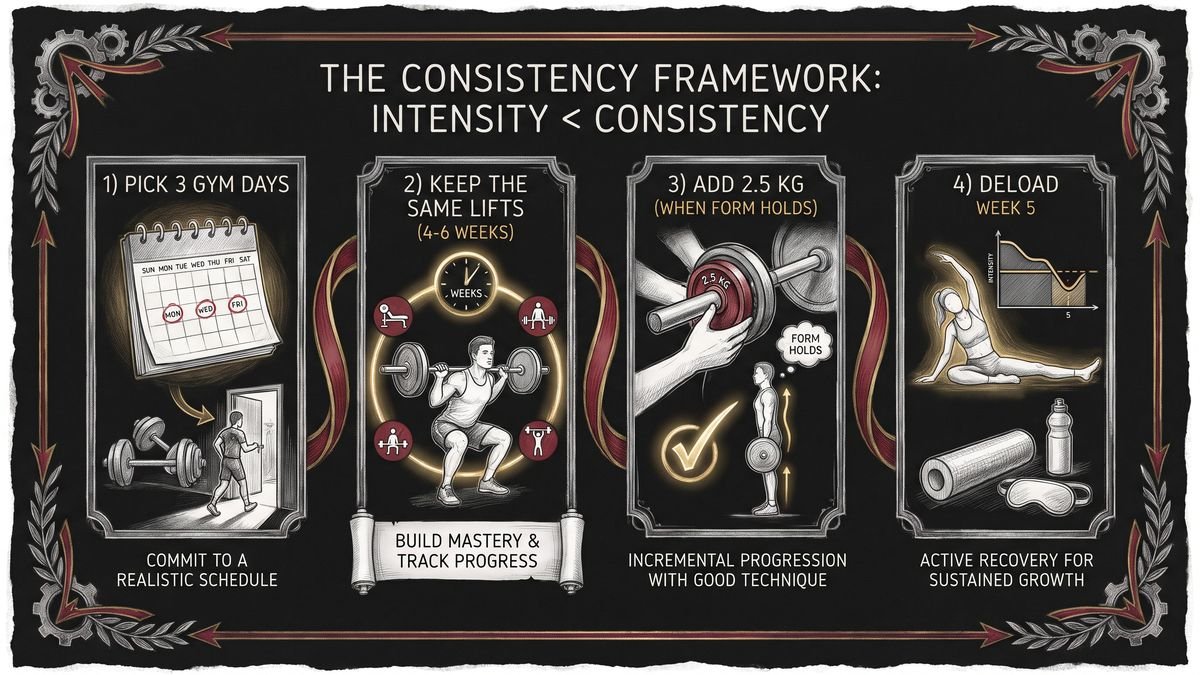
This is the framework I hand clients when they’re at the exact point this article describes – consistent but stalling. It’s four steps, and it works because each one addresses one of the four stalls above.
Step 1: Pick three gym days and keep them for four to six weeks. Not because three is magic, but because the system stops churning when you stop renegotiating the schedule every week. The days you choose should be non-consecutive where you can manage it, because recovery happens on the days between sessions.
Step 2: Keep the same lifts for that full window. Same compound movements, same accessory pattern, same rep range. The variety is what you add at the end of the block, not what you change halfway through it. Most plateau problems I see are actually confusion problems – the client keeps cycling between five different routines and can’t tell which one would have worked if they’d let it run.
Step 3: Add 2.5 kg when form holds. That’s the one progression rule you need. It’s small enough that it’s never a shock to the system, and it’s specific enough that you can’t argue with yourself about whether the set “felt harder.” If the rep range is 8 and form is clean, the next session is the same rep range at 2.5 kg more. If it isn’t clean, hold the weight and work on the reps.
Step 4: Deload in week five. Drop volume or intensity by roughly 40% for one week. This is the step that most programs skip, and it’s the one that keeps the progression in step three from becoming an injury or a stall. You don’t need to know why it works physiologically to know that it works practically – the clients who deload regularly report better energy in week six than the clients who kept pushing through week five “because the program says six weeks.”
Run that cycle, then restart it at a slightly heavier baseline. That’s the whole system. It doesn’t require a new supplement, a new app, or a new membership. It requires one honest 48-hour nutrition recall, a protected sleep window, a four-week commitment to the same lifts, and one deload week you actually take.
If you want the next layer – where a trainer adjusts the framework to your actual starting point, your injury history, and your schedule reality – that’s what a structured session is for. The personal fitness trainer in Delhi page covers what a coached program actually looks like versus a template you’re running alone, and which type of client the template stops working for.
How to run this for the next 30 days
The 30-day version is the one that’s actually executable, so here it is as a concrete list rather than a description.
Days 1-3: Do the 48-hour nutrition recall on two days that reflect your normal eating, not your best days. Write the gap down. You don’t need to fix it all at once. You need to know the size of it.
Days 4-7: Pick your three gym days for the block. Lock them in your calendar the way you’d lock a meeting, because that’s the level of commitment that keeps them from sliding. If you can’t lock three non-consecutive days, lock what you can and note which day is the one you’ll protect last.
Week 2: Run the same lifts as week one. Log the top working set of each compound movement. If form is clean at the top of the range on a set you can complete, that’s your signal to add 2.5 kg next session on that movement. If it isn’t, hold and work on reps.
Week 3: Mid-block check. Waist measurement, same position. Progress photo, same angle. If both have moved even a little in the right direction, the system is working – don’t change anything. This is the week most people break the system by, because nothing dramatic has happened and they interpret “nothing dramatic” as “nothing is working.”
Week 4: Final working week of the block. If you’ve been progressing 2.5 kg on clean form, the top of your range on week four should be noticeably heavier than week one. If it isn’t, look at the nutrition recall and the sleep log first, before you add another session.
Week 5: Deload. Cut volume or intensity by 40%. Use that week for sleep, walks, and the measurements you skipped during the working weeks. This is not a rest week in the “do nothing” sense. It’s a lower-stress week in the “let the adaptations consolidate” sense.
After week five, you start the next block at a slightly higher baseline. The 30-day version is the loop. Everything else in fitness programming is just a more complex way of doing the same loop with more moving parts.
What to do if the stall keeps coming back
If you’ve run the 30-day framework twice and you’re still at the same starting point on the scale and the waist measurement, the problem is no longer a framework problem. It’s a diagnosis problem, and it’s the point where a trainer who can actually look at your training data and your nutrition pattern and your sleep log together is worth more than another template.
The stall that keeps coming back is usually one of three things: a nutrition pattern that’s being quietly reset every time you think you’ve fixed it, a recovery debt that’s been accumulating for longer than you’ve been tracking it, or a programming mismatch where the split and the lifts aren’t actually targeting the tissue that needs to move. A structured session with a coach who has your actual numbers – not a generic program – is how you find which one it is.
The fitness coach for athletes page is a good next read if your goal is performance rather than aesthetics, because the diagnostic framework is the same and the outputs are different. For most people working through a stall like the one in this article, the personal training route is the shorter path.
The bottom line is the one that takes most people a plateau cycle to learn: the stall isn’t a signal that you need to work harder. It’s a signal that something in the system – the progression variable, the nutrition gap, the recovery window, or the measurement method – has stopped doing its job. Find the one that has, fix it for two weeks, and the next block runs clean.