
You start a new fitness routine excited. You pick a workout split that looks impressive on Instagram – push, pull, legs, upper, lower, five days a week. Two weeks in, you are sore in ways you did not expect, your schedule is collapsing, and you start skipping sessions. Then the guilt kicks in, and the whole thing unravels.
This happens more often than it should. A “split” sounds like a simple scheduling question, but it quietly decides whether you recover, stay consistent, and see results. For a beginner, the wrong split costs you the first two months – which is exactly when the biggest early gains happen.
Here is what a good split actually is, which one fits most beginners in India, and how to build one around a real life.
What Is a Workout Split, Really?
A workout split is a plan that divides your training across the days of the week. Instead of doing everything in one session, you assign muscle groups or movement patterns to specific days. The goal is simple: hit each target enough times to grow, while leaving enough rest between sessions that you can perform well and recover.
Splits fall into three families:
- Full-body sessions. Each session works the major muscle groups. Most beginner routines use 2 to 3 of these per week.
- Upper/lower split. Half the week is upper body, half is lower body. Common at 4 days per week.
- Push/pull/legs (PPL). Each session focuses on one of three patterns. Usually run 3 to 6 days per week.
The number of days per week and how the muscles are grouped are the two levers that matter. Everything else – the exact exercises, the rep ranges – is tuning, not the decision itself.
Why Beginners Should Not Copy Advanced Splits
The most common mistake is picking a split because it looks bigger, not because it fits your training age. A 6-day PPL program, for example, makes sense for someone who has been lifting consistently for a year or more. For a first-timer, it is a fast track to burnout, not progress.
Three reasons beginners lose at this step:
1. Volume tolerance is low. You can build up the amount of work your body handles over months. Jumping into high weekly volume on day one means you cannot recover, so you stop showing up.
2. Technique is still new. A beginner needs more frequency to practise the same movements. Doing a clean squat once a week is slower progress than doing it two to three times, with rest in between.
3. Consistency beats intensity early. Research on early training repeatedly points to the same thing: the program you actually do every week wins over the impressive program you abandon. A 3-day full-body routine completed for 12 weeks beats a 6-day PPL you quit in 3.
This is also why a lot of beginners over-rotate on single “bro splits” – one day chest, one day back. Each muscle gets one hard session per week. For an experienced lifter that can be a deliberate choice. For a beginner, it means most muscles are being stimulated only once per week, which under-trains them for growth.
The Best Split for Most Beginners: 3-Day Full Body
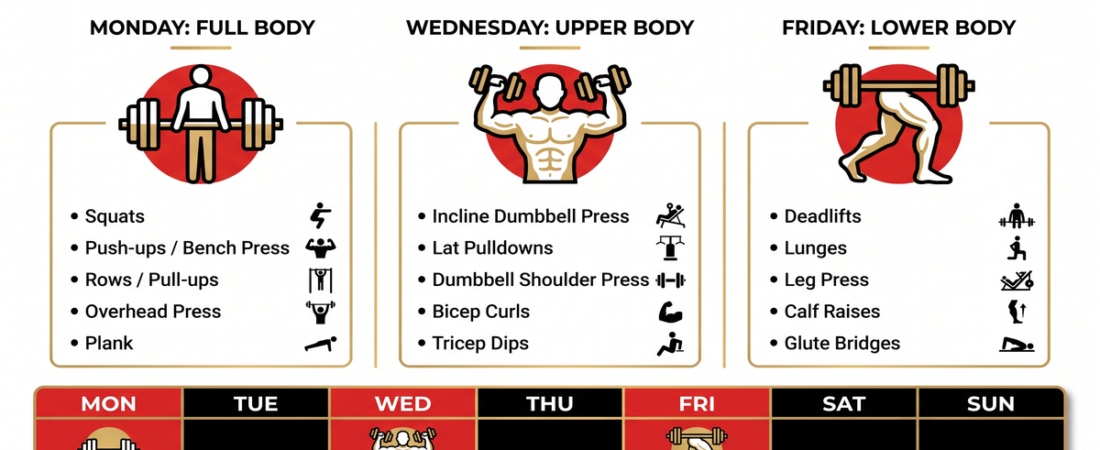
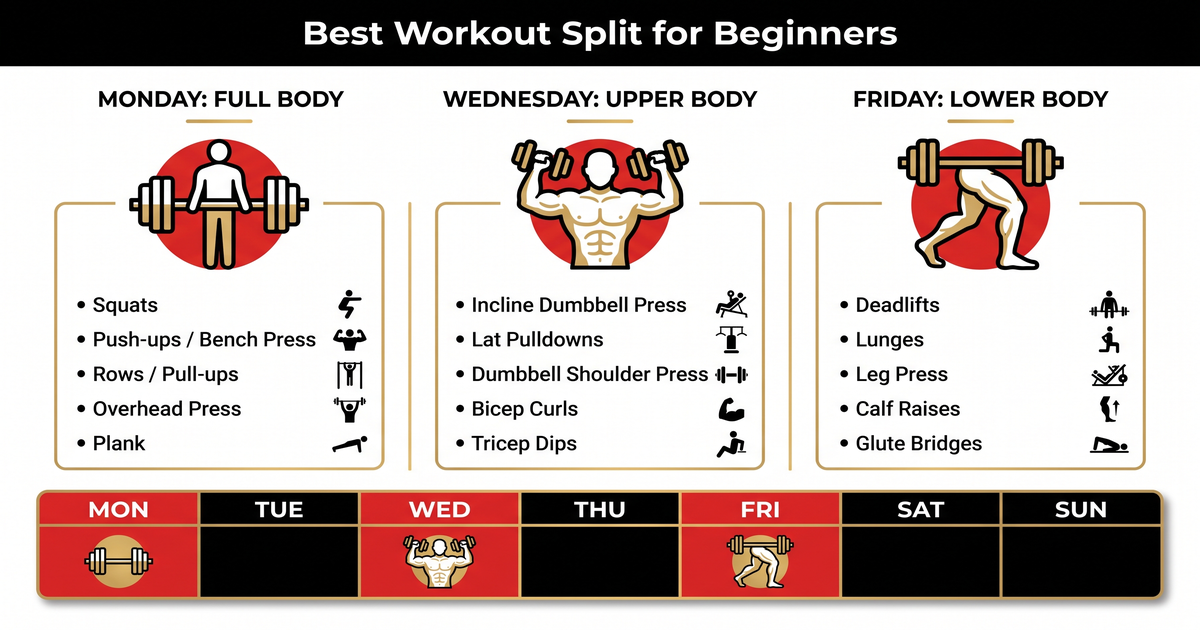
For someone new, the strongest starting point is a full-body workout three days per week, spaced with a rest day between sessions – for example Monday, Wednesday, Friday.
Why this is the default answer:
- Frequency. Each major muscle is trained about three times a week. Frequency is one of the drivers of early strength and size, and three touches a week is hard to beat for a beginner.
- Recovery. Rest days sit naturally between sessions, so you sleep and eat to recover instead of training through fatigue.
- Technique practice. You repeat the big lifts – squat, hinge, push, pull – often enough to actually get good at them.
- Time per session stays moderate. Around 45 to 60 minutes is realistic, which matters if you are working a full-time job in Delhi or Bengaluru.
It is not the most “advanced” looking option. It is the most effective one for where you actually are.
How to Structure Each Full-Body Day
You do not need to mirror the same three days exactly. Slight variation keeps sessions interesting and covers movement patterns well. A simple template for each day:
Day A (squat-anchored)
- Squat variation (back squat, goblet squat, or leg press) – 3 sets
- Push (bench press, push-up, or machine press) – 3 sets
- Hinge (deadlift variation or Romanian deadlift) – 3 sets
- Row (cable or dumbbell row) – 2 sets
- Plank or core work – 2 sets
Day B (hinge-anchored)
- Hinge (Romanian deadlift, kettlebell swing) – 3 sets
- Squat variation – 3 sets
- Press (shoulder press or incline press) – 3 sets
- Pull (lat pulldown or pull-up, assisted if needed) – 3 sets
- Lateral raise – 2 sets
Day C (mixed)
- Squat variation – 3 sets
- Row – 3 sets
- Push – 3 sets
- Hinge – 2 sets
- Core – 2 sets
Keep the rep ranges in the 8 to 12 window for most work, and leave the last set one or two reps short of failure. You are not chasing the last grind rep; you are chasing clean, repeatable sets across the week.
How to Set Sets, Reps, and Rest for a Beginner
You do not need to overthink the numbers. A starting framework that works:
- Sets: 3 sets for the main lifts, 2 sets for the accessory work.
- Reps: 8 to 12 for muscles you are trying to grow, 6 to 8 if you are focused on strength, 12 to 15 if endurance or conditioning is the priority.
- Rest: 90 to 120 seconds between strength sets. Shorter for accessories.
- Progression: add a small amount of work each week – a rep, a bit of weight, or an extra set on one lift. This is how you are guaranteed to get stronger.
If a beginner’s plan has you guessing the numbers or running 20 sets a day, it is too complicated. Simplicity is a feature, not a flaw, at this stage.
Choosing the Right Days and Keeping It Real
The split is only useful if it fits your week. A few practical notes for an Indian schedule:
- Rest day spacing matters. With three sessions, put at least one day between each. A Monday-Wednesday-Friday rhythm is clean and sustainable. If that does not work, Tuesday-Thursday-Saturday is just as good.
- Protect sleep and recovery. Training quality collapses if you are running on five hours. A good night of sleep is part of the program.
- Be honest about the time you have. A 45-minute session you keep up with is worth more than a 90-minute session you skip half the week.
- Match the split to your goal, then adjust. Losing weight, building muscle, or general fitness all run fine on the same 3-day structure – the difference is in what you do in and around the session, not in the split itself.
When to Move From Full-Body to an Upper/Lower or PPL Split
Do not switch on a timer. Switch on evidence. A good signal to graduate to 4-day upper/lower, or to add a PPL rotation, is when you are consistently completing every session, sleeping well, and wanting more volume per muscle. That usually lands somewhere between 3 and 6 months in.
A rough graduation path:
1. Months 1-3: 3-day full body. Build the base, learn the lifts.
2. Months 4-6: 4-day upper/lower, if you want more per-session focus while keeping rest days.
3. Month 6+: 5-6 day PPL, once you have the recovery and consistency to actually handle it.
The trap is skipping step one. Lifting a heavier weight on a PPL does not make up for two years of skipped fundamentals.
Nutrition and Recovery: The Part the Split Cannot Replace
No split works without the off-the-floor work. Three non-negotiables for a beginner:
- Protein at every meal. A simple target is roughly 1.6 to 2.2 grams of protein per kilogram of body weight per day. If you eat mostly vegetarian in India, that is a real constraint – you will need dairy, legumes, and possibly a supplement to hit the number. This is where a protein guide for Indian vegetarians earns its keep.
- Eat enough overall. Under-eating to “cut” while starting to lift usually means losing muscle you are trying to build. Small surplus if you are thin and want to grow; near-maintenance if the goal is recomposition.
- Sleep and recovery. Most beginners skimp here. The workout is the stimulus; the growth happens between sessions. Seven to nine hours of sleep is the baseline.
How to Know Your Split Is Actually Working
You will not see it on the scale. Track three things instead:
1. Progressive numbers. Strength lifts going up week over week, even a rep or a kilo at a time.
2. Consistency. How many of the planned sessions you actually did this month. The gap between planned and done is the real health check.
3. Recovery feel. Are you sleeping, eating, and still have energy between sessions? If every day feels drained, the split is too much, not too little.
A split that gets stronger numbers and keeps you consistent is the right one – not the one with the most days or the flashiest name.
Common Beginner Split Mistakes to Avoid
- Too many days too soon. Five or six sessions a week for someone who has never trained is a fast road to quitting.
- One muscle per week (the “bro split”). Under-stimulates most beginners. Frequency matters early.
- No progression plan. Doing the exact same thing every week produces the exact same result. Add something.
- Copy-pasting an advanced template. A program written for a competitive lifter is not a program for you.
- Neglecting the warm-up. Two minutes of light cardio and a couple of working sets is enough – but skip it and you raise your injury risk on every heavy set.
FAQ
What is the best workout split for beginners?
For most people starting out, a 3-day full-body split with rest days between sessions is the strongest default. Each major muscle is trained about three times a week, which is ideal for early strength and skill.
How many days a week should a beginner lift weights?
Two to three days per week is enough to build muscle and get stronger. If you add a fourth day, an upper/lower structure is the cleanest way to do it. Going above four days is rarely necessary at the start.
Is full body or push pull legs better for beginners?
Full body. A PPL split is built for higher weekly volume and better technique, which beginners do not have yet. Start full body, graduate to PPL later if the signal is there.
How long should I stay on the same split?
About three to six months on a 3-day full-body is a sensible first block. Stay longer if you are still progressing and enjoying it – consistency is not a bug.
Can I build muscle with only two days a week?
Yes. Two well-structured full-body sessions will still build some muscle, especially for a beginner. Three days is faster, but two is not wasted time.
Do I need to change my split if I want to lose weight instead of build muscle?
No. The split does not decide fat loss; your diet and total activity do. Run the same 3-day structure, focus on a sensible calorie deficit, and pair it with some everyday movement. The same program serves both goals.
What if my gym hours are limited?
Keep sessions under 60 minutes, lead with the main lift, and cut the accessories that are not pulling their weight. A short, done session beats a long, skipped one.
The Bottom Line
The “best” workout split for a beginner is not the busiest one – it is the one you will actually keep doing. For most people that is a 3-day full-body routine, done with progressive sets, real protein, and enough sleep. Build that base for a few months, watch the numbers go up, and then reach for the next split when your recovery and consistency can carry it.
If you are in Delhi and want the structure mapped to your goal – with the right split, the right rep ranges, and the right food plan – that is exactly what a good coach sorts out in one session. how to choose a personal trainer in Delhi covers what to look for so you do not end up paying for a printed sheet of exercises.
Richi Fitness is a training studio in Delhi working with beginner and intermediate lifters – strength, conditioning, and structured programs that actually get followed.