
Fitness Plateau Delhi: Why Progress Stalls and How to Break Through
Three months of consistent training. The same lifts, the same split, the same effort at every session. And the mirror has not moved since week six. The scale shows the same number, your lifts have not broken through since mid-cycle, and every rep of the last three sessions felt like the one before it.
That is a plateau. And it is not personal.
Every athlete who has trained for more than a few months has hit one. The lifters who do not stall out are not the ones who work harder. They are the ones who learned to read the signal, diagnose the cause, and adjust the program instead of just grinding through the same sessions with more intensity and less thought.
This guide is for you if you have trained at the same gym for six weeks or more, follow a split without changes, and you are not seeing progress in the strength, size, or fat-loss areas that matter most to you. It walks through the four places where progress stalls, the specific fixes for each, and when it is time to bring in an outside set of eyes.
What a Plateau Actually Is (and What It Is Not)
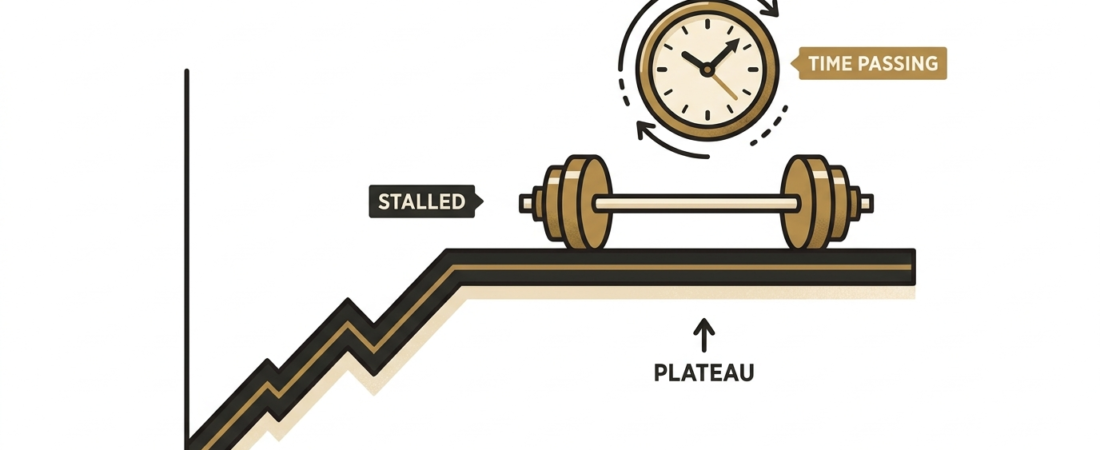
A plateau is a sustained failure to improve on a primary metric, not a bad week. A strength training program stalls for three to four consecutive weeks on a main lift. A fat-loss plan stalls when the scale sits at the same number for two to three weeks despite keeping the same diet and cardio volume.
What a plateau is not: a sign that your body has stopped being trainable. Your muscles, tendons, and bones are all still capable of adaptation. The stall comes from a mismatch between your program and your current ability. When you stop changing the stimulus, your nervous system stops responding, and the growth signal fades.
The most common mistake is to call it a plateau after one or two missed sessions, or to respond to a real plateau by just doing more of the same. Neither helps. Both make the stall longer and the recovery longer still.
Training Variance: Why the Same Split Stops Working
Your first program was new, so every lift was a new learning task. Your nervous system was working hard to encode the movement pattern, and that newness drove rapid gains. Once you have trained the same split for three to four weeks, that learning task is solved. The only thing left is to get stronger, and getting stronger requires a new challenge.
Here is what a variance block looks like in practice. For a four-week block:
- Weeks 1-2: Reduce your rep targets by 30 percent on the two main compound lifts. Keep the accessory work the same. The lighter load with the same rep range resets your base.
- Weeks 3-4: Rebuild. Add one working set to each compound. Bump the intensity up one rep target from your new baseline.
You do not need a new program. You need a different rep range, a different frequency, or a new accessory movement. Pick one change at a time so you can identify what moved the needle. If you change everything on the same week, you will not know what helped.
For a beginner or intermediate trainee running a full-body split, the single highest-impact change is usually rep range: drop to the low end (five to seven reps) on your primary compound lifts for two weeks, then rebuild up. That alone resets your strength curve in most cases.
If your split is not one you can justify on its own merits, a structured assessment of your best setup is worth having. A personal fitness trainer in Delhi who has programmed for lifters at your level can look at two weeks of your training logs and tell you whether your split is actually a problem or whether you just need one rep-range shift.
Progressive Overload: The Variable Most People Skip
Most plateau sessions look like this: you warm up, hit your working sets, and stop. No added weight, no added reps, no added volume across the session. The barbell does not move. The barbell only moves when you add a measurable challenge.
The rule is simple. On every training day, you must improve on at least one metric: a heavier working weight, an extra rep, a longer hold, a faster rep speed, or a shorter rest interval. Pick one and track it. If nothing is tracked, nothing is progressively overloaded. You are just doing the same session twice a week, which is not enough to build adaptation.
For a beginner, the first progressive overload that works is the smallest one: one rep on your working set. After you add that rep three sessions in a row, add the next smallest step, usually two to five pounds. A weekly journal or even the notes app on your phone is enough. The data is the program.
For a strength-focused athlete, overload looks like periodisation in miniature: a block of heavier loads, a block of higher volume, a deload, then a test. A strength and conditioning coach will typically build these blocks into the programming so you never have to guess when to shift from a strength focus to a volume focus and back.
Recovery and Sleep: The Variable You Underestimate
Progress does not happen while you are lifting. It happens while you are sleeping, eating, and standing still. The gym is where you create the stimulus. Recovery is where you adapt to it.
Here is what happens to your training when sleep drops below seven hours. Your cortisol levels run higher. Your protein synthesis drops on the next training day, so the same session produces less adaptation. Your perceived effort goes up because your central nervous system is fatigued, so you start to self-regulate on the reps you would otherwise have hit. The net effect is that you feel like you are training hard while your body is training soft.
In the Delhi context, this shows up in two predictable ways. The first is the daily commute: two hours of traffic each way cuts into sleep by twenty to thirty minutes on most days. The second is the late-night food window: dinner at eight, a second meal at ten, and a bed by two. Both hit recovery in ways that are hard to measure but easy to feel after a week.
A practical recovery reset looks like this: protect seven to eight hours of sleep for ten days. Cut one late-night meal. Add a protein shake on the day after a heavy leg session. That is the minimum. If the stall continues after ten days of better sleep, the problem is not recovery, and you can move on to the next variable.
Nutrition: The Two Places Caloric Deficits Fail
A plateau in fat loss almost always comes down to two numbers: your actual daily calories and your actual protein. People track the diet they planned, not the diet they ate. The gap between those two is where the stall lives.
The first gap is the ghee. An extra half-tablespoon of ghee in every dal, two teaspoons in the roti, and the extra pour at the plate means a surplus that is not visible on any meal plan. The second gap is the dessert. A daily slice of gulab jamun after dinner, a glass of lassi, or the two chandni churk you grab on the way home from the gym each adds 250 to 400 calories that never make it into the log.
Protein is the other number. For fat loss, you need 1.6 to 2.2 grams of protein per kilogram of body weight to preserve muscle in a deficit. Most vegetarians in Delhi fall short because they build the meal around carbs and not protein, and the protein that is there is spread thin across six small meals instead of two large ones. If you are not tracking protein, start there: log every source for three days and see the number. If it is under 1.4 g/kg, you are in the deficit that eats your muscle.
For a vegetarian athlete, the fix is not elimination, it is a restructuring. Pair your dal with a 20-gram whey isolate, and you clear 80 to 90 percent of the daily target in two meals. For a deeper look at how to build that around an Indian vegetarian plate, see our guide to protein sources for Indian vegetarians, which covers the full daily protein map with realistic Indian ingredients.
When It Is Time to Bring in a Trainer
You can fix most plateaus on your own with the four levers above: variance, overload, recovery, nutrition. The plateau becomes a hard problem when you have already cycled through those four variables with no movement, when you are not sure which lever is the actual binding constraint, or when you keep making the same form error on the lifts that are stalling your numbers.
That is the moment a personal fitness trainer in Delhi earns their fee. A good trainer does not just add volume. They pull up your last six weeks of logs and your last three weeks of food and tell you which of the four variables is the one that is not being executed. That is a service you cannot replicate with an app.
If your goal is not general fitness but a specific sport or performance outcome, the calculus changes. A strength and conditioning coach will look at the demands of your sport and build the block accordingly. For a beginner who has not set a baseline yet, the first conversation is usually about your first day at the gym and what the first four weeks of training should actually look like before you worry about any plateau. For a beginner who is still figuring out what split works, start with the best workout split for beginners guide so your program has a sound structure before you stack variance changes on top of a weak foundation.
Frequently Asked Questions
How long is a normal plateau in strength training?
Two to four weeks of no visible progress is common for most lifters. It happens because your nervous system adapts to the same stimulus, so the same rep targets start yielding less growth signal. When the flatline stretches past four to six weeks with consistent effort, your program has outlived its usefulness and needs to change.
How do I break a plateau in weight loss?
Cut the gap between what you think you eat and what you actually eat. A daily serving of ghee-rich dal, a glass of lassi, or two chandni churk after dinner can silently offset a deficit without feeling like food. Track three unprocessed days, cut back two of those extras, and drop your cardio volume if recovery is suffering.
How long does it take to see results in the gym?
Beginners see measurable strength gains in two to four weeks and visible body composition changes in eight to twelve. A first deload or program switch can reset progress within one to two weeks of the change landing, not six months.
Is a plateau a sign my body stopped responding to training?
No. A plateau is a mismatch between your program and your current ability, not a biology problem. Your muscles, tendons, and bones are all still adaptable. The mismatch lives in the rep targets, recovery, nutrition, and sleep you are feeding the same lifts week after week.
Bottom Line
A plateau after three months is not a sign that your body is done with you. It is a sign that your program is done with you. The fixes are boring and they all point in the same direction: change one variable, track it, give it two to four weeks, and do not stack the next change on top until the first one has had time to work. Most stalls break within ten days of a single well-targeted adjustment.