
You spend an hour scrolling through YouTube. A 45-minute beginner full-body circuit from one coach. A 12-week strength program from another. A “no gym needed” plan that promises visible results in three weeks. By the time you close the tab, you end up with 14 workouts and zero idea which one to actually do. That is the real problem for most people starting to train in Delhi: it is not finding a routine, it is finding the one routine that you will keep doing.
Richi Singh has coached people through exactly this mess for years. The honest answer is that no beginner routine is “best.” A good routine is the one you will repeat for 8 to 12 weeks without it feeling like a punishment. This guide walks through how to pick yours, what a first program should look like, and where people usually go wrong.
What a first workout routine should actually be
A beginner program has one job: build the habit and teach your body the basic movements. Everything else is secondary. That means three qualities matter more than any exercise list:
- Frequency you can actually hold. Three days a week that you keep for three months beats five days a week that you quit in three weeks.
- Simple structures. Full-body sessions, or a straight upper/lower split. No push-pull-legs, no 45-minute ab work, no “abs and glutes Monday.”
- Minimal equipment demands. A home dumbbell setup or a single gym visit is enough. The fewer logistical hurdles, the more sessions you will show up to.
Most first programs are overbuilt. A routine with nine exercises, five “finishers,” and a weekly progression table looks impressive on paper and dies by week two. Keep it boring on purpose.
How many days a week should a beginner train?
This is the most-asked question, and the answer is less dramatic than the internet makes it sound.
Three days is the floor that works. If you are still deciding which overall training shape fits you, our breakdown of the best workout split for beginners is a good companion to this guide. Two days will maintain you. Four or five days is fine if the volume per session stays moderate, but the extra days create two risks: more fatigue you do not know how to manage yet, and more “life happens” days where you miss a session. If you are completely new, start at three. You can always add a day; you cannot easily recover from three missed weeks.
Should beginners train every day?
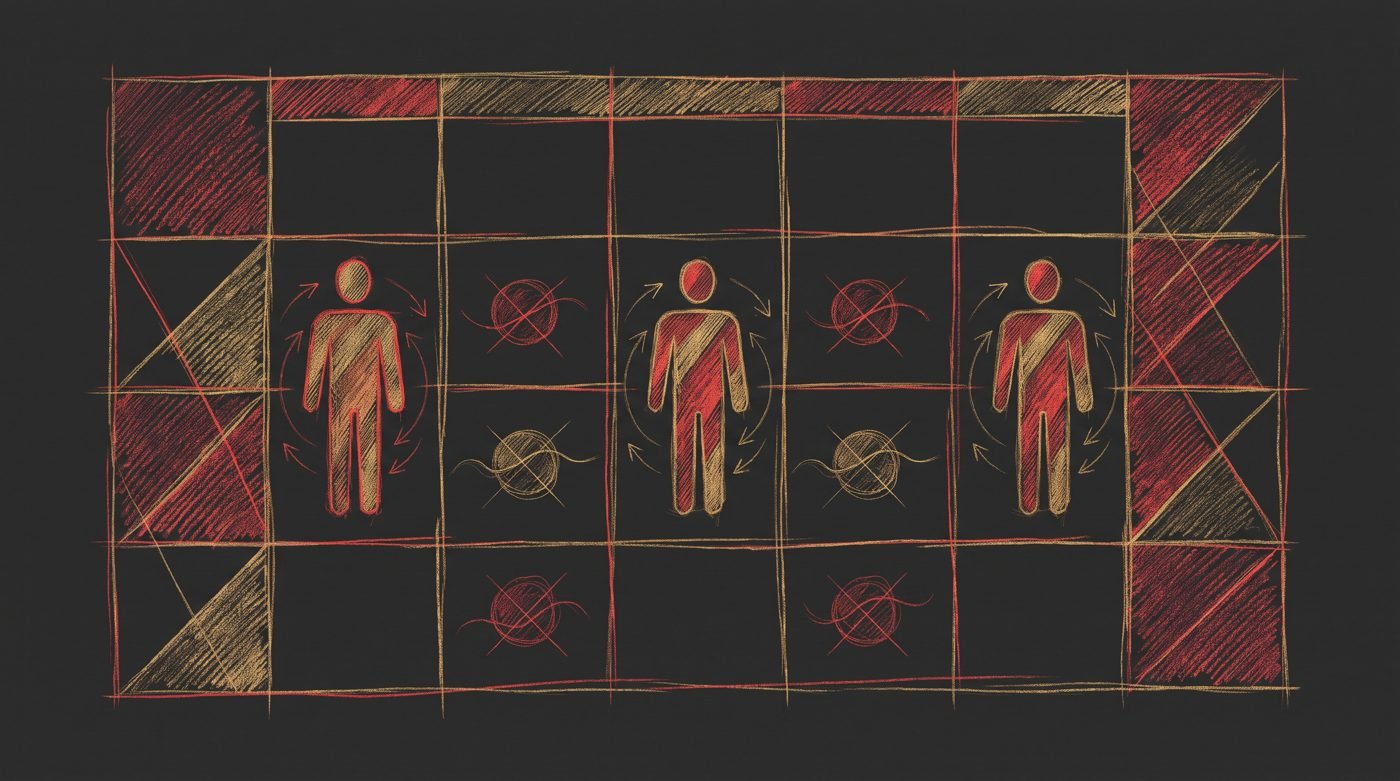
No, and this deserves its own answer because everyone wants it to be yes. Muscles grow during recovery, not during the workout. A day between sessions of the same muscle groups is not wasted time, it is when the adaptation happens. A realistic beginner pattern:
- Day 1: Full body
- Day 2: Rest or a 20-minute walk
- Day 3: Full body
- Day 4: Rest
- Day 5: Full body
- Day 6-7: Active rest (walk, stretch, household chores count)
You see the pattern: you train three days, you recover three days, you repeat. This is not a “soft” plan. It is the plan that keeps you in the gym a year from now.
How often should you do strength training vs cardio?
You do not need to choose one. Beginners get the best results when both are in the mix, and the balance is simpler than you think: two to three strength sessions per week plus one to two short cardio sessions.
Cardio for a beginner should stay easy: a brisk walk, a slow jog, cycling, or swimming. The goal is not to burn calories, it is to get your heart used to sustained work and to build a daily movement habit. Twenty to thirty minutes at a pace where you can still hold a conversation is the right zone. If you gasp out each sentence, slow down.
Where beginners blow it up: cardio that makes the strength session feel pointless. If you do a 45-minute run and then lift weights, the lifting is going to be sloppy. Put cardio after strength on the same day, or on separate days.
What exercises should a beginner's routine include?
Pick one movement from each of these five patterns, and you have a complete program:
| Pattern | Example exercise | Why it matters |
|---|---|---|
| Squat pattern | Bodyweight squat, goblet squat, or barbell back squat | Legs drive everything. This is the first pattern to learn |
| Hinge pattern | Glute bridge, Romanian deadlift, or kettlebell swing | Teaches the hip hinge, loads the posterior chain |
| Push pattern | Push-up, dumbbell press, or machine chest press | Builds the front of the shoulders and chest |
| Pull pattern | Pull-up or assisted row, cable row | Balances the pushing and builds the back |
| Carry pattern | Farmer's carry | Teaches posture and grip strength, used almost nowhere else |
If any of those look intimidating, that is your cue. Do not jump to the barbell version. Start with the bodyweight or dumbbell entry point in each row, and only graduate when the top of the list feels easy. The progression is: learn the movement with light load, add load slowly, only then worry about form refinement.
How should you progress in your first 8-12 weeks?
Progression is the part everyone skips, because it is not exciting. The rule is called progressive overload and it means one thing: do a little more each week. That little more can be:
- One more rep on an exercise
- Two more kg on the bar
- A slower tempo on the lowering half of the lift
- Or a fifth set on one key movement
You do not need to do all of these. Pick one channel and chase it. A simple template: for weeks 1 through 4, focus on movement quality with light loads. Weeks 5 through 8, start adding small weight increments. Weeks 9 through 12, you are ready to add sets or reps. The numbers stay small on purpose; consistency is the whole game.
A useful check: if your last three sessions of a lift are at the same weight and same reps with the same feel, you are not progressing. Add the next step. If you have to struggle for every rep, you added too much.
The three most common beginner mistakes
Most of the “why is my program not working” problems trace back to one of these:
- Changing the program too often. You will feel like something is wrong in week two, because the old habit is dying and the new one is not yet automatic. That feeling lasts about three weeks, then disappears. Stay the course for a full 8-week cycle before you judge the program.
- Skipping the easy days. The hard sessions get priority, which is correct, but the light sessions are where the volume builds. One heavy day and two easy days is a program; one heavy day and two “rest” days is not.
- Measuring progress by the mirror on day one. You will not look different in week two. You will be different in the way you move, sleep, and handle work stress, and those changes compound. The mirror catches up in weeks 6 to 8 if you are actually consistent.
What a 4-week sample routine looks like
Here is a concrete plan you can start this week, assuming three gym days and one cardio day:
**Monday (Full body A):**
- Goblet squat, 3 x 10
- Dumbbell row, 3 x 10 each side
- Push-up or dumbbell press, 3 x 8-12
- Glute bridge, 2 x 15
- Farmer’s carry, 2 x 30 meters
**Wednesday (Full body B):**
- Back squat or air squat, 3 x 8
- Assisted pull-up or cable row, 3 x 10
- Dumbbell shoulder press, 3 x 10
- Romanian deadlift (light), 2 x 10
- Plank, 3 x 30 seconds
Friday (Full body A, repeat, or substitute a new variation)
Saturday: 25-minute walk or easy cycle
Load starts light enough that the last rep of each set still feels controlled. Add a small increment the following week. That is the whole program. Boring? Yes. It also works. For the first week specifically, read what to do on your first day at the gym so the session itself is not the obstacle.
How to know if your routine is actually working
Stop tracking your weight on the scale as a primary signal and start tracking three things instead:
- Volume consistency. Did you complete the planned sessions? Aim for at least 85% of planned weeks over a 12-week span.
- Reps and weights. Are the numbers going up, even slowly? Ten percent more over three weeks is real progress.
- How the session starts. If the first set is easy and the last set is hard, the program is in the right zone. If all sets are easy, it is time to add load. If all sets are hard, you added too much.
This is the feedback loop that replaces motivation. You stop waiting to “feel motivated” and you just look at the numbers on Tuesday: the last session was slightly better than the one before it, so this week you add a small increment. That is the entire engine of progress.
When to bring a trainer in
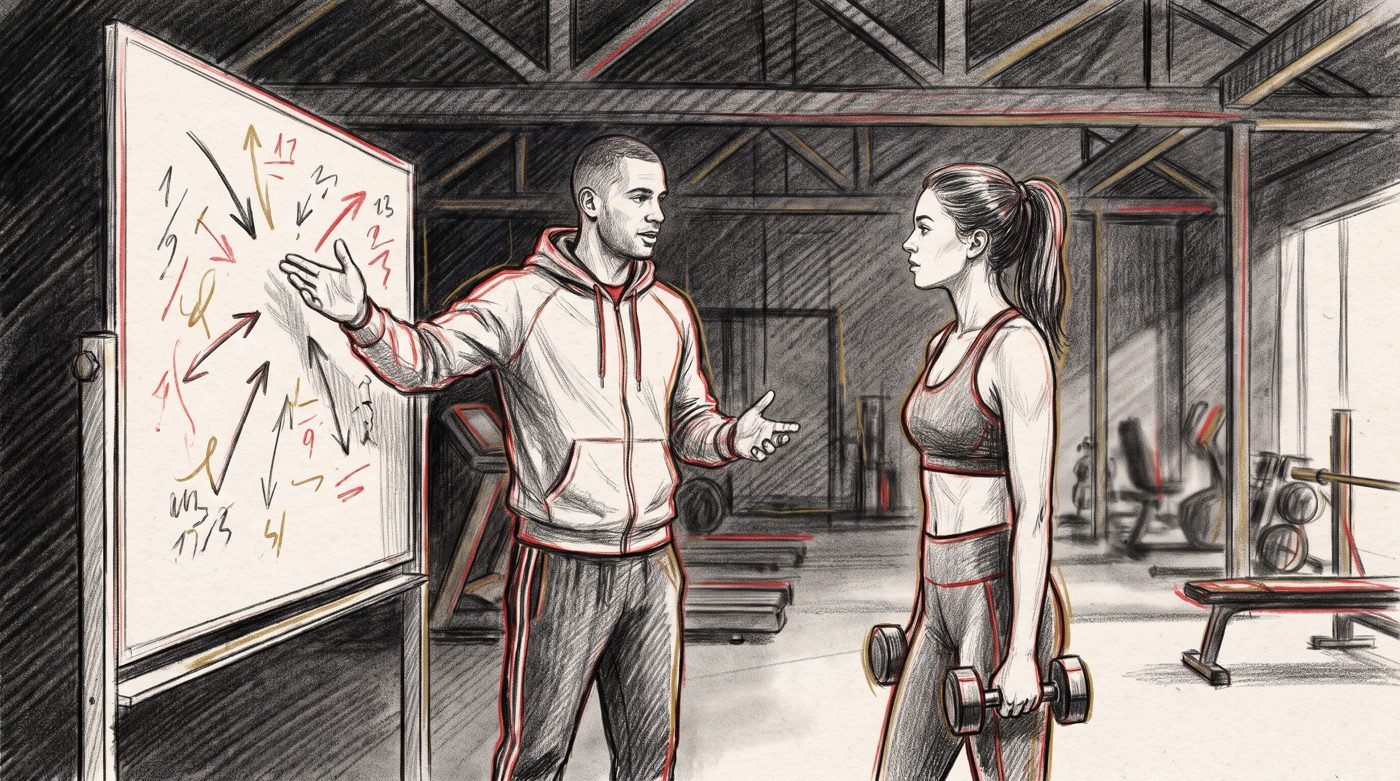
There are two honest signals that a trainer is worth the money: the program is not progressing because the lifts are technically breaking down, or you are not showing up because nothing is making the sessions feel non-negotiable. A good trainer in Delhi, like the coaches at Richi Fitness, will give you a written program, measure the numbers weekly, and adjust the load on a predictable schedule. You will not be guessing what to do next session, which is where most solo programs quietly die.
A red flag on the other side: a trainer who never writes the program down and tells you to “just feel it.” Movement should be a system. If you cannot look at a sheet of paper and know exactly what to do, you are not getting a program, you are getting opinions.
How to stay consistent in the first month
Consistency for beginners is not willpower. It is removing friction. Three things that work better than motivation:
- Schedule the sessions like meetings. Put them in the calendar with a name and a time. If you are not in the gym by that time, the calendar tells you the exact moment you lost the week.
- Pack the bag the night before. The decision of what to wear and what to bring is a small friction that kills sessions at 7 AM.
- Set a minimum viable session. Some days the full program is not going to happen. A 15-minute session of the top three lifts beats nothing. “I at least did something” is the bridge that gets you back to the next full session.
The first month is a calibration period. You are learning what time of day you actually show up, how much sleep you need before a session, and which days of the week are reliably available. Build the routine around that data, not around the idealized version of your week.
Q: Building a beginner workout routine
How long until I see results from a beginner routine?
Expect measurable strength gains within 4 to 6 weeks if you are consistent and progressively overloading. Visible body composition changes usually appear in the 8 to 12 week window, and the earliest visible change for most people is not in the mirror but in how clothes fit and how they feel after a long day. If you are under six weeks in and nothing has happened, the program is not the problem; the session count is.
Should I split my workouts or do full body?
Full body three days a week is the right structure for a first program. Splits only start to matter once you can consistently do three to four quality sessions per muscle group per week, which is not a beginner situation. Keep full body until you are at least three months in and your technique is stable.
What if I can only train two days a week?
Two full body days is still a program. It will be slower than three days but it is not wasted. The only thing it cannot do is build a lot of extra volume; that is the tradeoff, not a failure. If two days is what you have, make the two days strong, and add a 20-minute walk on the off days.
Do I need to do cardio if my goal is to build muscle?
Yes, but keep it light and brief. Twenty to thirty minutes of easy cardio supports the heart and lungs, which is the engine that lets you recover between sets. Cut it back only on the day immediately before your heaviest lifting session, not every day.
Is it better to follow a YouTube program or build my own?
For your first 8 to 12 weeks, following a written program is better than building your own, because the structure is the product. Once you have the basic movements down, building your own around the patterns in this guide becomes manageable and is when the program becomes yours.
How do I know if a routine is too hard for a beginner?
The clearest signal is that the last two or three sets of a lift feel like you are guessing the weight, and your form visibly breaks down. A beginner load should feel like 70 to 80% of your max effort, with two or three reps in the tank. If you finish a session feeling completely wrecked and shaky, you went past that zone. Scale back by one increment and it will still progress.
Next Steps
If this is the program you want, the cleanest way to start is a free consultation session where your routine gets mapped to your actual schedule and equipment. Call or WhatsApp Richi Fitness to book one, or start with this guide as a baseline and adjust from there.