
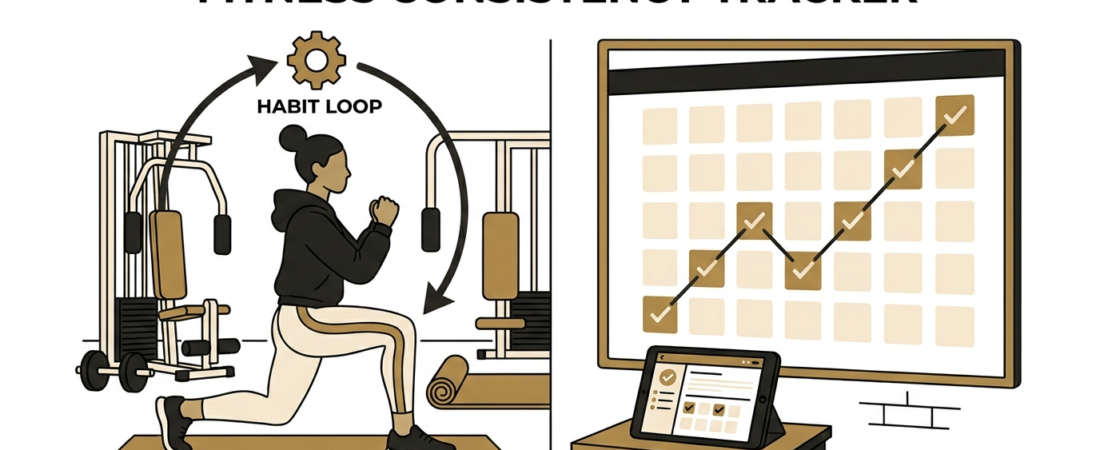
How to Stay Motivated in Fitness: Build the System, Not the Mood
You probably have better motivation at 8 AM on day one than you think. What kills the program is not the start. It is the quiet Tuesday at week six when the rain hits Delhi at 5:30 PM, the AC at work makes the house feel far away, and “tomorrow” sounds more reasonable than “go now.” No one is watching. Nothing dramatic happens if you skip. That is the entire problem: fitness is one of the few things in life where the default setting is that you stop.
The good news is that the people who stick with training are rarely the ones with more willpower. The 2018 Psychological Bulletin review by DuBois and colleagues found the strongest link between consistent exercise and goal commitment, not mood – and commitment is something you can engineer. Your environment decides the outcome. Design yours, and motivation stops being the thing you need every morning.
This guide walks through exactly how to build that system: why motivation fails, how to commit to training, the first-week protocol, and how to keep it alive when the novelty wears off.
Why Motivation Always Fades (and What Actually Replaces It)
Here is the pattern most people go through: intense energy for two weeks, a few skipped sessions, a rationalization (“I did three, that counts”), and then a restart that is just the first restart repeated. The restart itself is not the failure – it is proof the habit was never built. Motivation is fuel, not the vehicle. It burns out because it is an emotion, and emotions run on their own schedule.
The thing that replaces it is commitment, which is a decision you make once and enforce automatically. Researchers at the University of British Columbia found a 30-second pre-exercise commitment script – “I am committed to completing today’s workout” – improved completion rates on subsequent days by about a third. You do not need to meditate for that. You need a trigger, a default, and a floor.
The trigger
Attach the workout to something you already do every day – the alarm, the tea, the commute exit. “When I pour the chai, I put on my gym clothes” is the whole system. If the trigger never fires, the habit never starts. Pick one trigger you never skip.
The default
Decide in advance what you will do on a bad day, so the bad day never has to negotiate with you. Negotiation is where you lose. A bad day is not a rest day – it is a different workout. More on that in the floor section below.
The floor
The floor is the minimum version of a session that still counts: ten minutes, one short walk, one mobility round. The floor protects the identity. You stop being a person who works out and you become a person who works out every day – sometimes heavily, sometimes on the floor. Both are the same habit.
How to Commit to a Fitness Goal Without Quitting at Week Two
Most goals die in the gap between the decision and the system. “I will get fit” is a wish; a system is a schedule with specific days, a location, and an exit condition. The gap is where motivation evaporates, so close it before you start.
Write the decision down, publicly, with a date
Not a journal entry. A public or semi-public statement: tell one friend, or post the date and the first workout. Social commitment roughly doubles follow-through in adherence studies – the accountability cost of quitting becomes real. A vague “I will get fit someday” has no quitting cost, which is why it fails quietly.
Pick a training frequency you can defend in February
If your plan needs six days a week to work, it will not survive the first cold Delhi morning in January. Two to three days a week, each one with a full-body stimulus, outperforms a daily plan that quits by week three. The research base is solid here: meta-analyses of exercise adherence show higher-frequency plans have worse drop-off, and the single biggest predictor of sticking with a plan is that it is realistic under your actual conditions, not your ideal ones.
Put the gear where the trigger fires
Shoes by the front door, not the basement. Gym clothes in the car on the first day, not the second. Friction compounds: every extra step in the morning is a small tax on a habit that is already under-resourced. The friction in the other direction – the reason not to train – is also a design problem. If the phone goes in the gym bag, it does not vibrate on the bench. If the gym bag stays at home, the phone stays on the table.

How to Stay Motivated When You Do Not Feel Like It
“I do not feel like it” is not a fact about your fitness level. It is a fact about the last forty-eight hours of your life – sleep, work stress, the one bad meal that made you feel like the whole week was ruined. The feeling is data about you, not about the workout. Most of the time the workout is the remedy for the feeling, not the cause of it.
The 10-minute rule
On days when the resistance is heavy, start with ten minutes. The rule is not “work out for ten minutes and then stop.” It is “work out for ten minutes, and if you still do not want to continue, you are allowed to stop.” In practice, most people keep going, because the resistance was mostly a doorway problem. The first two minutes of a workout are the hardest; by minute five, the body is warm, the rhythm is set, and the original resistance has lost most of its argument. The 10-minute rule converts the decision from “do an hour of work?” into “do ten minutes?” – and that is a decision the body makes for you.
Pre-decide the bad day in advance
Before the bad day arrives, write down what you will do on it. Not a full session – a short one that still touches the muscle groups that matter to your goal. Ten minutes of mobility, a brisk walk, a set of bodyweight work in the hallway. The point of the pre-decided bad day is that it is not a bad day. It is a low day, and low days protect the streak. Skipping one workout is normal; skipping the system is what actually breaks you.
Never miss twice – the real version
The “never miss twice” rule sounds motivational, which is why most people skip it the third time. The real version: you are allowed to skip one workout, but the next scheduled session is non-negotiable. A skipped session is a data point. Two in a row is a pattern, and a pattern is a new default. The second miss is where the old you reclaims the schedule. Make the second miss the hard one, not the first.
Track only what you can control
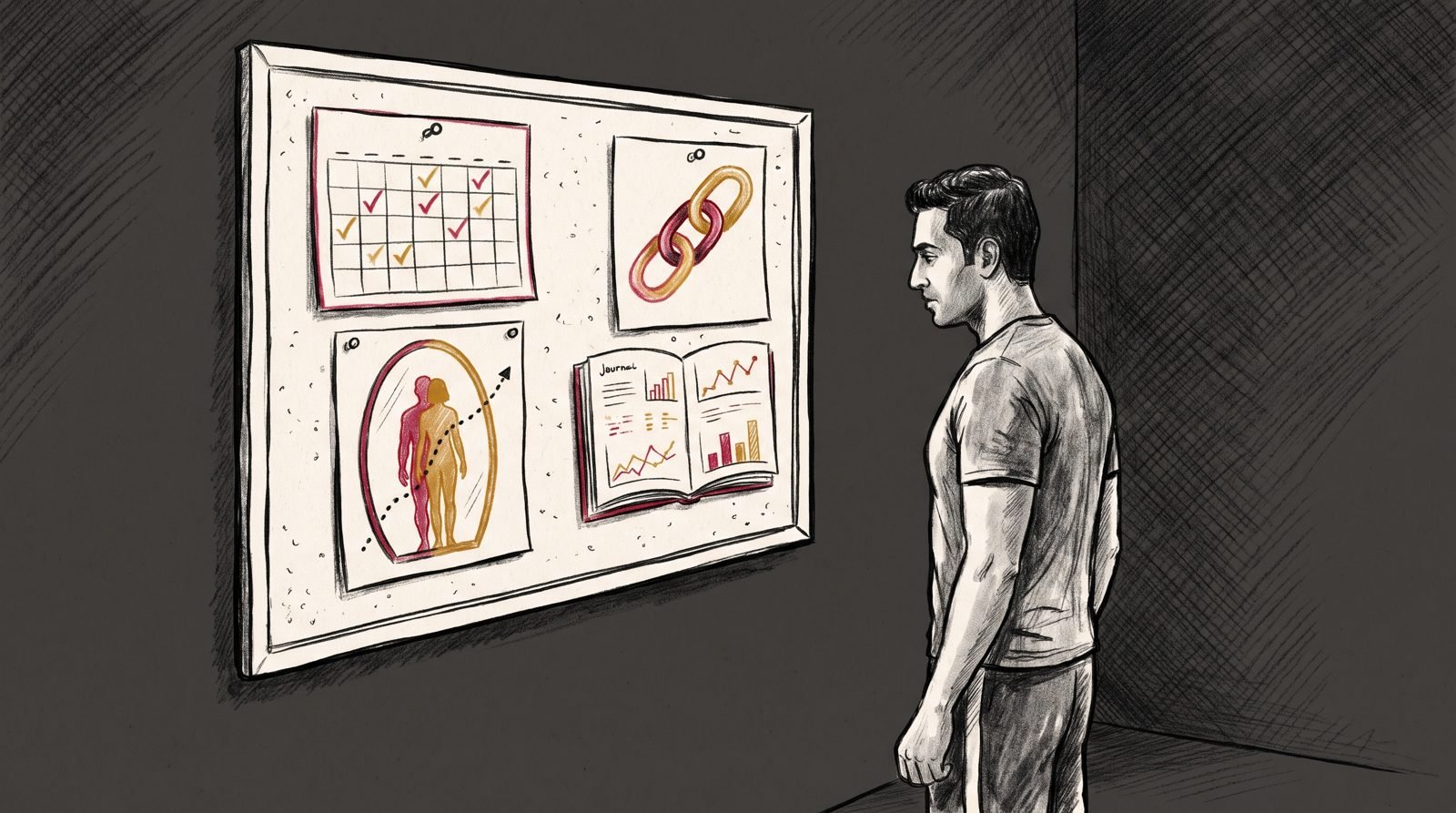
Weight, photos, and strength numbers all move slowly and in waves. They are fine for the long term. For the day-to-day motivation loop, track sessions done, not outcomes done. A simple calendar with X marks is enough. The streak is the reward; the outcome is the long game. If you are only tracking outcomes, you will feel bad for weeks at a time, and bad-feeling weeks are when the habit dies. The streak keeps the habit alive on the bad weeks.
How to Build a Daily Workout Routine That Sticks
A routine that sticks is not the most ambitious routine. It is the one that survives your worst week – the week with the deadline, the illness, the family trip, the rain. Design for the worst week, not the best one. If your routine cannot survive a bad week, it is not a routine; it is a hope.
Build the 4-week skeleton
Week 1: two sessions of 25 minutes, full-body, at the same time on the same days. Do not add variety yet. Repetition is the whole point – the goal of week one is to get the two sessions in without negotiation. Week 2: add a third session, keep the two anchor days. Week 3: bump two of the sessions to 35-40 minutes, add one new exercise. Week 4: review the streak – how many sessions did you actually hit, what made you miss, what was the one change that helped most? Then start the next cycle with the winning version.
The daily trigger map
Each training day has three parts: the trigger (the fixed event that fires), the gear (the physical setup that must be in place the night before), and the floor (the minimum version). If any of the three is missing, the session will not happen, and it will not be because of willpower. It will be because of a gap in the system. The system is the thing you build; the motivation is the thing you stop needing.
Protect the sleep
Most undertraining in Delhi is not undertraining – it is under-recovering. A 2 AM phone session with the lights on and the AC blasting will cancel the stimulus from the morning workout. Sleep is the non-negotiable: the workout makes the adaptation, the sleep is where the adaptation actually happens. Set a hard cut-off – screens off 30 minutes before the alarm, or no scrolling after the last session. The body is not a machine you can override with caffeine and short sleep. The workout is only as good as the recovery that follows it.
How to Stay Motivated in the Gym Long-Term
Month one is the easy part. The body is new, the schedule is new, the social energy is high. By month three the novelty is gone, the progress is slower, and the reason to keep showing up is just… showing up. That is the point where most programs die, and it is the point where the system has to carry the load.
Rotate the variables, keep the structure
Change the exercise selection, the rep ranges, the order of the movements – not the frequency, not the days, not the time of day. The structure is the habit; the variables are the interest. A person who rotates their exercises every four weeks and keeps the same three days is more likely to be training in year two than a person who builds a perfect program and gets bored by month three. The structure is the commitment. The variables are the reward.
Pair the habit with something you actually enjoy
Podcasts only on the treadmill. Music only in the gym. A specific coffee after the session. The pairing is not optional decoration – it is the reward structure that makes the habit pull instead of push. If the gym is neutral, the habit needs external motivation. If the gym is where the good podcast lives, the habit pulls itself.
Read the season, not the day
Some weeks you will train four sessions and feel great. Some weeks you will train two and feel fine. Neither week tells you where the program is going. Look at the month. The month is the real unit of progress – the streak is the month’s floor, the training volume is the month’s signal. Judge the month, not the Tuesday. The Tuesday is just a Tuesday.
Common Mistakes That Kill Fitness Motivation (and How to Fix Them)
Treat every day as a new decision
If every morning is a fresh vote on whether to train, you will lose the vote more than half the time. The decision was made once, in advance. The morning is just execution. If you find yourself negotiating with the alarm, the system has a gap – the trigger fired but the gear was not in place. Fix the gap; do not re-vote.
Make the rest day the problem
Rest days feel like a betrayal of the goal, so people skip them, get irritated, stop sleeping well, and train the next day in a fog. The rest day is part of the program. It is where the adaptation happens. A rest day is not a gap in the habit – it is a feature of it. The program is sessions, recovery, and sleep. All three are the habit.
Wait for the mood to arrive
The mood is not coming. It is not a weather system you can wait out. The mood is the output of the habit – the streak gives the mood, the mood is not the prerequisite. This is the most important reframe in the whole article: do not wait to feel motivated. Start the ten minutes, and the feeling will follow. Sometimes it will not follow that day, and that is fine. The habit is not the feeling. The habit is the thing you do regardless of the feeling.
Optimize the workout instead of the schedule
Spending forty minutes on the phone building the perfect superset for a Tuesday workout is a form of avoidance. The workout content is not what makes the habit stick – the schedule does. Build the schedule first. The content can be simple and effective for a long time. The content can be changed. The schedule, if it breaks, breaks the habit.
How to Keep Training When Results Are Slow
Progress is not linear, and the people who quit at the plateau are usually the ones who were doing the right thing and just cannot see it yet. The scale is a blunt instrument that ignores body composition shifts – you can be getting stronger, look different, and weigh the same. The mirror and the barbell are the honest numbers; the scale is the marketing. Here is how to stay in the program through the slow middle:
- Set a floor and a ceiling. The floor is the minimum volume per session. The ceiling is the maximum. The slow middle is where you live between the two. If you are below the floor, the habit is not being practiced. If you are above the ceiling, the recovery is not happening. The middle is where the progress compounds.
- Track the trend, not the single reading. One bad week is not a signal. One good month is not a signal. The signal is the direction of the three-month trend. If the trend is flat, adjust the program – not the commitment. If the trend is down, look at the floor: is the sleep off? Is the nutrition off? The program is not broken. The recovery is.
- Change the metric for 30 days. If the scale has been flat for six weeks, stop looking at it for a month. Use the strength numbers, the energy, the sleep, the clothes. The scale will come back with the new composition. The month without it is where the confidence gets rebuilt.
- Compare to the version of you from two months ago. Not to the person you are trying to become. That comparison is always a loss, and it is the one that kills the habit. The honest comparison is the one that is already done – the version of you who did not have the streak, who did not have the schedule, who did not have the system. That person is the baseline. Everything since is the win.
The slow middle is not a failure of the program. It is the program working at the rate the body can actually adapt, which is slower than the motivation promised on day one. The system is the thing that gets you through the middle. You do not need more motivation for the slow middle. You need the calendar, the floor, and the thirty-day metric rotation. The motivation is the byproduct, not the input.
The Richi Fitness Approach to Long-Term Commitment
At Richi Fitness in Delhi, the commitment system is the first thing we build – before the program, before the assessment, before the first session. It is the calendar, the floor, the trigger map, and the recovery protocol. The program is the what. The system is the why and the when. If the system is not in place, the program will not survive February. If the system is in place, the program is just the content of the sessions.
We also build the streak together in the early weeks, because the early weeks are when the habit is most fragile and the external structure (the coach, the schedule, the accountability) is what carries the load. Once the streak is three weeks long, the habit has its own gravity. The coach becomes the person who adjusts the program, not the person who makes you show up.
If you want the structure without building it from scratch – the calendar, the floor, the recovery protocol, the 4-week skeleton – that is what personal fitness training at Richi Fitness is for. The system is the point. The program is the content. Start with the system, and the program will follow.
The first step is the one you can take today: pick the trigger, place the gear, write down the floor, and put the first session on the calendar. Not the full month. The first session. The second step is the second session. The habit is the thing that shows up both days. Everything else is the system – and the system is the thing that works.
For the rest of the training side: if you are a beginner setting up the split for the first time, our beginner split guide covers what to put in each of the two or three sessions. And if you have ever wondered why the schedule you built for yourself in January has no effect on the calendar in February – this one on workout timing in Delhi will tell you why the time-of-day choice matters more than the total hours.