

If you have been training hard for months and your numbers have not moved, the missing piece is usually not effort. It is structure. A strength and conditioning coach in Delhi builds that structure around your sport, your body, and your calendar instead of handing you a generic gym template and hoping for the best.
Most athletes in the capital do the same thing: lift weights in the off-season, run a bit when a tournament gets close, and then wonder why the last over feels heavy or why the final quarter of a match turns their legs to stone. Strength and conditioning is the discipline that connects raw gym strength to actual sporting performance, and getting it right requires a coach who understands both the physiology and the sport.
This guide explains what a strength and conditioning coach does, how the role differs from a regular personal trainer, what the work looks like across a competitive year, and how to choose the right person in Delhi.
What Does a Strength and Conditioning Coach Do?
The best way to understand the role is to think of it as performance engineering. A strength and conditioning coach studies what your sport demands physically, tests where you currently stand, and then builds a training plan that closes the gap.
That work usually breaks into five components:
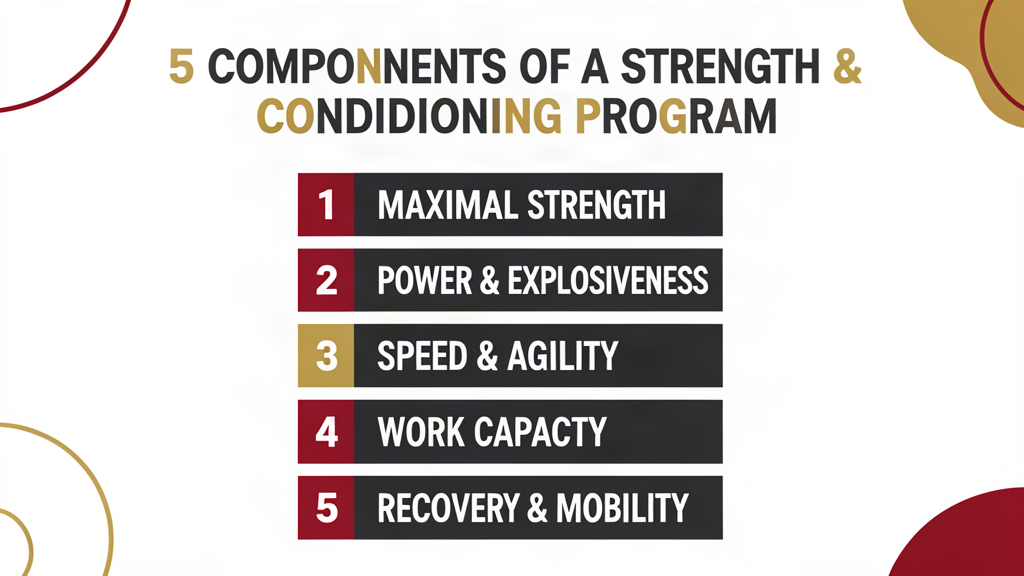
Maximal strength is the base layer. For a cricketer it might mean a stronger posterior chain for faster bowling and a more stable front leg when batting. For a football player it means the ability to hold off a challenge without losing balance.
Power and explosiveness turn that strength into speed. This is where jumps, throws, Olympic lift variations, and medicine ball work come in. Power is what makes a sprint to the crease or a first step into a tackle look effortless.
Speed and agility are sport-specific. A badminton player needs lateral change of direction over two metres. A 400m runner needs repeatable top-end mechanics. The drills look nothing alike because the demands are nothing alike.
Work capacity determines whether you can hold your technique together in the last fifteen minutes of a match. This is the conditioning layer, and it is the one most athletes get wrong by simply running long distances.
Recovery and mobility tie everything together. Adaptation happens between sessions, not during them, so sleep, nutrition, and structured mobility work are part of the program, not an optional extra.
A coach also manages load week to week. Every athlete has a ceiling on how much stress they can absorb before injury risk spikes. Tracking readiness through sleep quality, soreness, and performance markers is how a good coach keeps you in the productive zone rather than the red zone.
Strength and Conditioning Coach vs Personal Trainer: The Difference
This is the question athletes in Delhi ask most often, and the distinction matters because the two roles solve different problems.
A personal trainer helps you get fitter, leaner, and stronger in a general sense. The typical outcome is better body composition, more energy, and a consistent training habit. That is genuinely valuable, and for a lot of people, a fitness trainer in Delhi is exactly the right starting point.
A strength and conditioning coach starts from a performance question rather than a fitness question. What do you need to do better on the field, and what physical quality is limiting you right now? The program is then reverse-engineered from that answer.
In practice, that changes the whole shape of the work. You will see more testing and re-testing, more attention to movement quality under load, more periodisation, and a training calendar built around your competition dates. You may also see the coach working with your sport coach to align what happens in the gym with what happens in practice.
Many coaches can do both, and the overlap is real. The difference is the starting point and the amount of sport-specific detail in the plan.
Why Delhi Athletes Need Structured Conditioning
Delhi presents a set of constraints that make unstructured training especially costly.
The climate is the obvious one. Summer temperatures from April through June make afternoon outdoor sessions genuinely dangerous, which pushes conditioning work indoors or into early mornings. Winter air quality in November and December forces a similar adjustment. A coach who has trained athletes through Delhi’s seasons knows how to maintain conditioning volume when outdoor work is not viable, and how to use indoor cycling, rowing, and circuit formats to preserve fitness without losing the training effect.
Facility access is the second constraint. Serious athletes in the city rarely have year-round access to a full turf or track, so good programming has to be portable. The best plans in Delhi are built to run in a commercial gym, a small turf, and a home setup without falling apart.
The competition calendar is the third factor. School and university sport, club cricket, district athletics, and state-level tournaments all cluster in particular windows. Training that peaks at the wrong time wastes months of work, and a coach who understands periodisation plans backwards from your tournament dates rather than forwards from today.

How a Strength and Conditioning Program Runs Through the Year
A well-built program moves through distinct phases. Understanding them helps you evaluate whether a coach’s plan is actually structured or just varied for the sake of variety.
Assessment phase. Before any program is written, there should be testing. Expect movement screening, strength benchmarks, and sport-specific conditioning tests. Without a baseline, there is no way to measure progress, and progress is the entire point.
General preparation phase. This is the longest block, typically running through the off-season. Volume is high, intensity is moderate, and the goal is building a broad physical base: tendon and ligament resilience, work capacity, and the strength foundation that everything else sits on.
Specific preparation phase. Intensity climbs and volume drops. Training starts to look like the sport. Power work increases, conditioning becomes more sport-specific, and technical qualities under fatigue get more attention.
Competition phase. Here the job is maintenance rather than development. You train to stay strong and healthy while the games themselves provide the stress. Programs become shorter and sharper, and recovery work becomes the priority.
Transition phase. After the season, a short period of active recovery lets the body reset before the next cycle begins. Skipping this phase is one of the most common causes of burnout injuries in young athletes.
If a coach hands you a plan with the same exercises in the same sets and reps for twelve months straight, the plan is not periodised, regardless of how it is labelled.
What to Look for in a Delhi Strength and Conditioning Coach
Credential checking in India is uneven, so a certificate alone tells you very little. Here is what actually matters.
They test before they program. Ask what assessment you will go through in week one. A coach who cannot answer this clearly is guessing.
They know your sport. A coach who has worked with cricketers understands the demands of fast bowling and the specific hip and shoulder issues that come with it. A coach who has worked with runners understands cadence, ground contact, and the difference between aerobic and speed endurance. Sport-specific experience is not optional.
They explain the why. You should leave a session understanding what a drill is for. If your coach cannot articulate the purpose of an exercise in plain language, that is a warning sign about how carefully the program was designed.
They coordinate with your sport coach. The best outcomes in Delhi come from a conditioning coach who talks to the person running your team practice. Conflicting messages about volume and intensity cause injuries.
They track and adjust. Programmes should change based on how you are responding. A plan that gets emailed once and never revised is a template, not coaching.
They are honest about timelines. Meaningful strength and power changes usually take eight to twelve weeks of consistent work. Anyone promising a dramatic transformation in three weeks is either measuring the wrong thing or not measuring at all.
If you want a deeper sense of how this looks in practice, the strength and conditioning work in Delhi that Richi Fitness delivers follows exactly this assessment-first, periodised structure.
Training Around Sport-Specific Demands
The conditioning work for different sports looks radically different, and this is where generic programs fail hardest.
Cricket is an intermittent sport. A fast bowler needs repeatable high-intensity efforts followed by long recovery periods, plus the trunk and shoulder durability to survive a season. The conditioning emphasis falls on repeat-effort capacity and rotational power. If you are building for the sport, the cricket fitness training in Delhi approach focuses heavily on exactly these qualities.
Football and other field sports demand high aerobic base plus repeated sprint ability and change of direction. The sports performance training model you need is built around interval work with short recovery, combined with deceleration and landing mechanics to protect the knees and ankles.
Racket sports, athletics, and swimming each have their own signature demands. A coach who has trained across sports can map your requirements onto a program quickly. A coach who has only worked with bodybuilders will default to a hypertrophy plan no matter what sport you play.
For athletes juggling multiple demands, or for those who want the full picture beyond conditioning, the complete performance guide for athletes in India covers how the pieces fit together.
Common Mistakes Delhi Athletes Make
A few patterns show up again and again, and they all cost months of progress.
The first is skipping the base. Athletes who jump straight into explosive work without building a strength foundation get injured or plateau within weeks. The off-season is for building, not for peaking early.
The second is conditioning by long-distance running. Jogging builds a very specific aerobic quality that has limited transfer to most team sports. It also eats into recovery capacity that could be spent on high-quality work.
The third is ignoring recovery. Training is the stimulus, not the adaptation. If you are sleeping five hours a night and wondering why your strength has stalled, the program is not the problem.
The fourth is changing programs every three weeks. Adaptation requires sustained, progressive overload. Jumping between methodologies means you never accumulate enough consistent stress to force an adaptation.
The fifth is training hard in season and resting in the off-season, which is exactly backwards. The off-season is when development happens.
Final Thoughts
Strength and conditioning is not complicated in principle. Assess where you are, build a base, add sport-specific speed and power, manage load carefully, and let recovery do its job. What is hard is doing it consistently with a plan that actually fits your sport and your season.
That is where a specialist earns their value. If you are serious about performing better on the field and not just looking better in the mirror, structured coaching shortens the path considerably. At Richi Fitness, Richi Singh works with athletes, teams, and weekend competitors across Delhi who want programming built around their sport rather than pulled off a template, including small group training in Delhi for athletes who train better alongside others.

If you want to know which physical quality is actually holding your performance back, start with an assessment rather than another random training block. Reach out to Richi Fitness and get a plan built for your sport, your season, and your schedule.